Airflow Orchestration
Overview
Apache Airflow orchestrates the Spark feature engineering job. A single DAG runs daily and delegates computation to Spark via the SparkSubmitOperator.
System Design | Spark Processing
DAG Structure
The quantum_feature_processing DAG consists of a single task that submits a PySpark application to the Spark cluster.
DAG Configuration
with DAG(
    'quantum_feature_processing',
    default_args={
        **default_args,
        'retries': 3,
        'retry_delay': timedelta(minutes=20),
    },
    description='Process quantum experiment data into ML feature tables',
    schedule_interval=timedelta(days=1),
    start_date=datetime(2025, 1, 1),
    catchup=False,
    tags=['quantum', 'ML', 'features', 'processing', 'Apache Spark'],
    on_success_callback=send_success_email,
) as dag:
    # Single task: submit Spark job
    quantum_simulation_results_processing = SparkSubmitOperator(
        task_id='run_quantum_processing',
        application='/opt/airflow/dags/scripts/quantum_incremental_processing.py',
        conn_id='spark_default',
        name='quantum_feature_processing',
        conf={...},       # Spark configuration
        env_vars={...},   # Runtime environment variables
        verbose=True,
    )
Configuration Parameters
| Parameter | Value | Description |
|---|---|---|
schedule_interval |
timedelta(days=1) |
Runs daily at midnight |
start_date |
datetime(2025, 1, 1) |
First eligible execution date |
catchup |
False |
Does not backfill historical runs |
retries |
3 |
Retries failed tasks up to 3 times |
retry_delay |
timedelta(minutes=20) |
20-minute pause between retries |
tags |
['quantum', 'ML', ...] |
Tags for filtering in the Airflow UI |
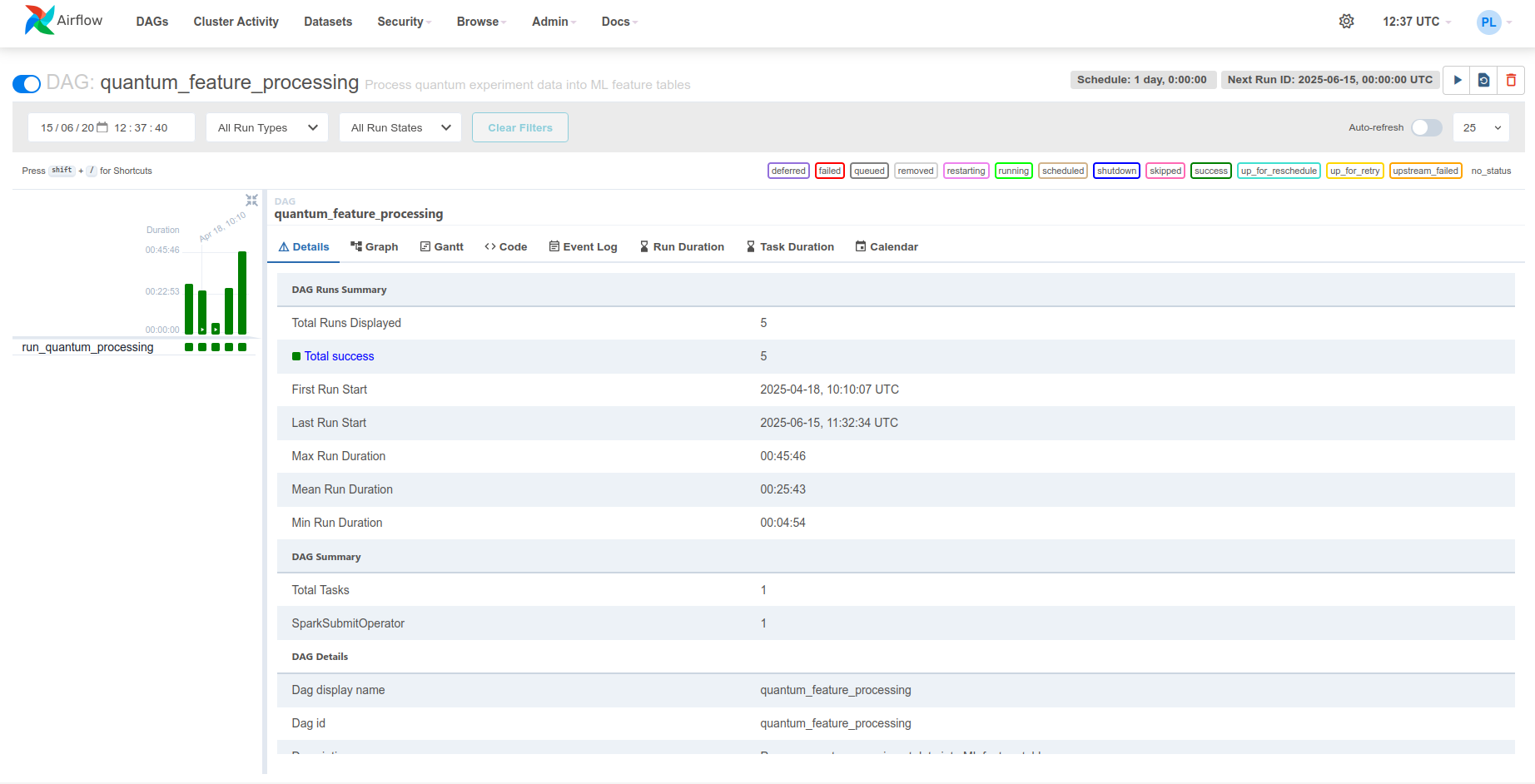
SparkSubmitOperator
The SparkSubmitOperator constructs and submits a spark-submit command to the Spark master.
Operator Configuration
quantum_simulation_results_processing = SparkSubmitOperator(
    task_id='run_quantum_processing',
    application='/opt/airflow/dags/scripts/quantum_incremental_processing.py',
    conn_id='spark_default',
    name='quantum_feature_processing',
    conf={
        'spark.master': Variable.get('SPARK_MASTER'),
        'spark.app.name': Variable.get('APP_NAME'),
        'spark.hadoop.fs.s3a.endpoint': Variable.get('S3_ENDPOINT'),
        'spark.hadoop.fs.s3a.access.key': Variable.get('MINIO_ACCESS_KEY'),
        'spark.hadoop.fs.s3a.secret.key': Variable.get('MINIO_SECRET_KEY'),
        'spark.hadoop.fs.s3a.path.style.access': 'true',
        'spark.hadoop.fs.s3a.connection.ssl.enabled': 'false',
        'spark.jars.packages': (
            'org.slf4j:slf4j-api:2.0.17,'
            'commons-codec:commons-codec:1.18.0,'
            'com.google.j2objc:j2objc-annotations:3.0.0,'
            'org.apache.spark:spark-avro_2.12:3.5.5,'
            'org.apache.hadoop:hadoop-aws:3.3.1,'
            'org.apache.hadoop:hadoop-common:3.3.1,'
            'org.apache.iceberg:iceberg-spark-runtime-3.5_2.12:1.4.2'
        ),
    },
    env_vars={
        'MINIO_ACCESS_KEY': Variable.get('MINIO_ACCESS_KEY'),
        'MINIO_SECRET_KEY': Variable.get('MINIO_SECRET_KEY'),
        'S3_ENDPOINT': Variable.get('S3_ENDPOINT'),
        'S3_BUCKET': Variable.get('S3_BUCKET'),
        'S3_WAREHOUSE': Variable.get('S3_WAREHOUSE'),
        'SPARK_MASTER': Variable.get('SPARK_MASTER'),
    },
    verbose=True,
)
Operator Parameters
| Parameter | Value | Description |
|---|---|---|
application |
/opt/airflow/dags/scripts/quantum_incremental_processing.py |
Path to the PySpark script inside the Airflow container (source) |
conn_id |
spark_default |
Airflow connection ID for the Spark cluster |
name |
quantum_feature_processing |
Application name visible in the Spark Web UI |
verbose |
True |
Enables detailed Spark logging in Airflow task logs |
Package Dependencies
The spark.jars.packages configuration specifies Maven packages downloaded at runtime:
| Package | Version | Purpose |
|---|---|---|
spark-avro_2.12 |
3.5.5 | Read/write Avro files |
hadoop-aws |
3.3.1 | S3A filesystem connector for MinIO |
hadoop-common |
3.3.1 | Hadoop core libraries |
iceberg-spark-runtime-3.5_2.12 |
1.4.2 | Apache Iceberg integration |
slf4j-api |
2.0.17 | Logging framework |
commons-codec |
1.18.0 | Encoding utilities |
j2objc-annotations |
3.0.0 | Annotation compatibility |
Variables Management
All runtime settings are stored as Airflow Variables and retrieved at DAG parse time.
Default Configuration
DEFAULT_CONFIG = {
    'S3_ENDPOINT': 'http://minio:9000',
    'SPARK_MASTER': 'spark://spark-master:7077',
    'S3_BUCKET': 's3a://local-vqe-results/experiments/',
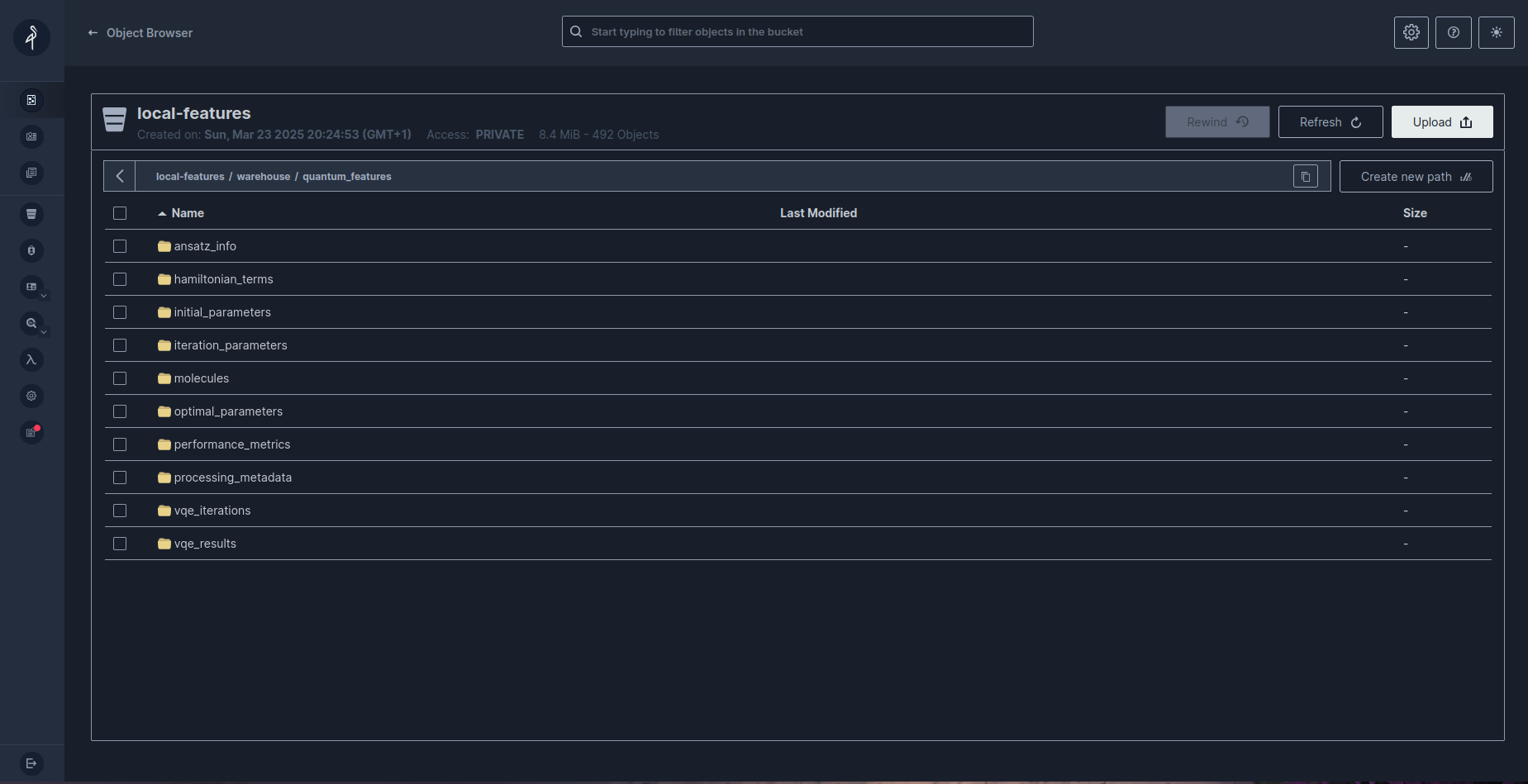
    'S3_WAREHOUSE': 's3a://local-features/warehouse/',
    'APP_NAME': 'Quantum Pipeline Feature Processing',
}
Variable Initialization
Variables are initialized with defaults on first run and updated from environment variables for secrets:
# Set defaults if not already configured
for k, v in DEFAULT_CONFIG.items():
    if Variable.get(k, default_var=None) is None:
        Variable.set(k, v)

# Set secrets from environment
Variable.set('MINIO_ACCESS_KEY', os.getenv('MINIO_ACCESS_KEY'))
Variable.set('MINIO_SECRET_KEY', os.getenv('MINIO_SECRET_KEY'))
Variables Reference
| Variable | Default Value | Description |
|---|---|---|
S3_ENDPOINT |
http://minio:9000 |
MinIO endpoint URL |
SPARK_MASTER |
spark://spark-master:7077 |
Spark master address |
S3_BUCKET |
s3a://local-vqe-results/experiments/ |
Source bucket for raw Avro data |
S3_WAREHOUSE |
s3a://local-features/warehouse/ |
Iceberg warehouse location |
APP_NAME |
Quantum Pipeline Feature Processing |
Spark application name |
MINIO_ACCESS_KEY |
(from environment) | MinIO access credential |
MINIO_SECRET_KEY |
(from environment) | MinIO secret credential |
Accessing Variables
Email Notifications
The DAG sends email notifications on both success and failure.
Success Callback
def send_success_email(context):
    """Send a detailed success email with processing summary."""
    task_instance = context['task_instance']
    results = task_instance.xcom_pull(task_ids='run_quantum_processing')

    subject = f'Quantum Processing Success: {context["execution_date"]}'
    html_content = f"""
    <h3>Quantum Processing Completed Successfully</h3>
    <p><b>Execution Date:</b> {context['execution_date']}</p>
    <p><b>Processing Results:</b></p>
    <pre>{results}</pre>
    <p>View the <a href="{context['task_instance'].log_url}">logs</a>
       for more details.</p>
    """
    send_email(to=default_args['email'],
               subject=subject, html_content=html_content)
Default Arguments
default_args = {
    'owner': 'quantum_pipeline',
    'email': ['quantum_alerts@example.com'],
    'email_on_failure': True,
    'email_on_retry': False,
}
| Parameter | Value | Description |
|---|---|---|
email_on_failure |
True |
Send email when the task fails after all retries |
email_on_retry |
False |
Do not send email on individual retry attempts |
The retry strategy uses 3 retries with a 20-minute delay between attempts, allowing recovery from transient infrastructure failures (Spark cluster unavailability, MinIO overload, network issues). For details on Airflow retry configuration, see the Airflow documentation.
Execution Flow
Complete execution cycle from scheduler trigger through Spark processing to completion notification.
sequenceDiagram
    participant S as Airflow Scheduler
    participant E as Airflow Executor
    participant SSO as SparkSubmitOperator
    participant SM as Spark Master
    participant SW as Spark Workers
    participant M as MinIO
    participant I as Iceberg

    Note over S: Daily trigger at 00:00
    S->>E: Schedule quantum_feature_processing
    E->>SSO: Execute run_quantum_processing

    SSO->>SSO: Read Airflow Variables
    SSO->>SM: Submit PySpark job

    SM->>SW: Distribute tasks

    par Read Raw Data
        SW->>M: Read Avro files from experiments/
    end

    SW->>SW: Transform to feature tables

    par Write Features
        SW->>I: Write to Iceberg tables
    end

    I->>I: Create snapshot
    I->>M: Persist Parquet files

    SW->>SM: Report completion
    SM->>SSO: Job finished
    SSO->>E: Task success
    E->>S: Update DAG state

    alt Success
        S->>S: Send success email
    else Failure (after retries)
        S->>S: Send failure email
endExecution Steps
- Scheduler trigger - At midnight (or the configured schedule), the Airflow scheduler identifies that
quantum_feature_processingis due for execution. - Task queuing - The executor queues the
run_quantum_processingtask. - Variable resolution - The
SparkSubmitOperatorreads all Airflow Variables (endpoints, credentials, cluster address). - Spark submission - The operator constructs and executes a
spark-submitcommand targeting the Spark master. - Task distribution - The Spark master distributes processing tasks to worker nodes.
- Data processing - Workers read raw Avro files from MinIO, transform data into feature tables, and write Parquet files through Iceberg.
- Snapshot creation - Iceberg creates a new snapshot recording the processing state.
- Completion - Spark reports success to Airflow, which updates the DAG state and triggers the success email callback.
Related Documentation
- System Design - Full architecture overview
- Spark Processing - Details on the Spark job triggered by Airflow
- Iceberg Storage - How processed data is stored and managed
- Docker Compose - Container deployment for the Airflow service
- Environment Variables - Environment variable reference